463/3
How to See the Northern Lights
The aurora is never guaranteed, but the odds improve a lot once you know where to stand, when to look up and which forecast really decides the night.
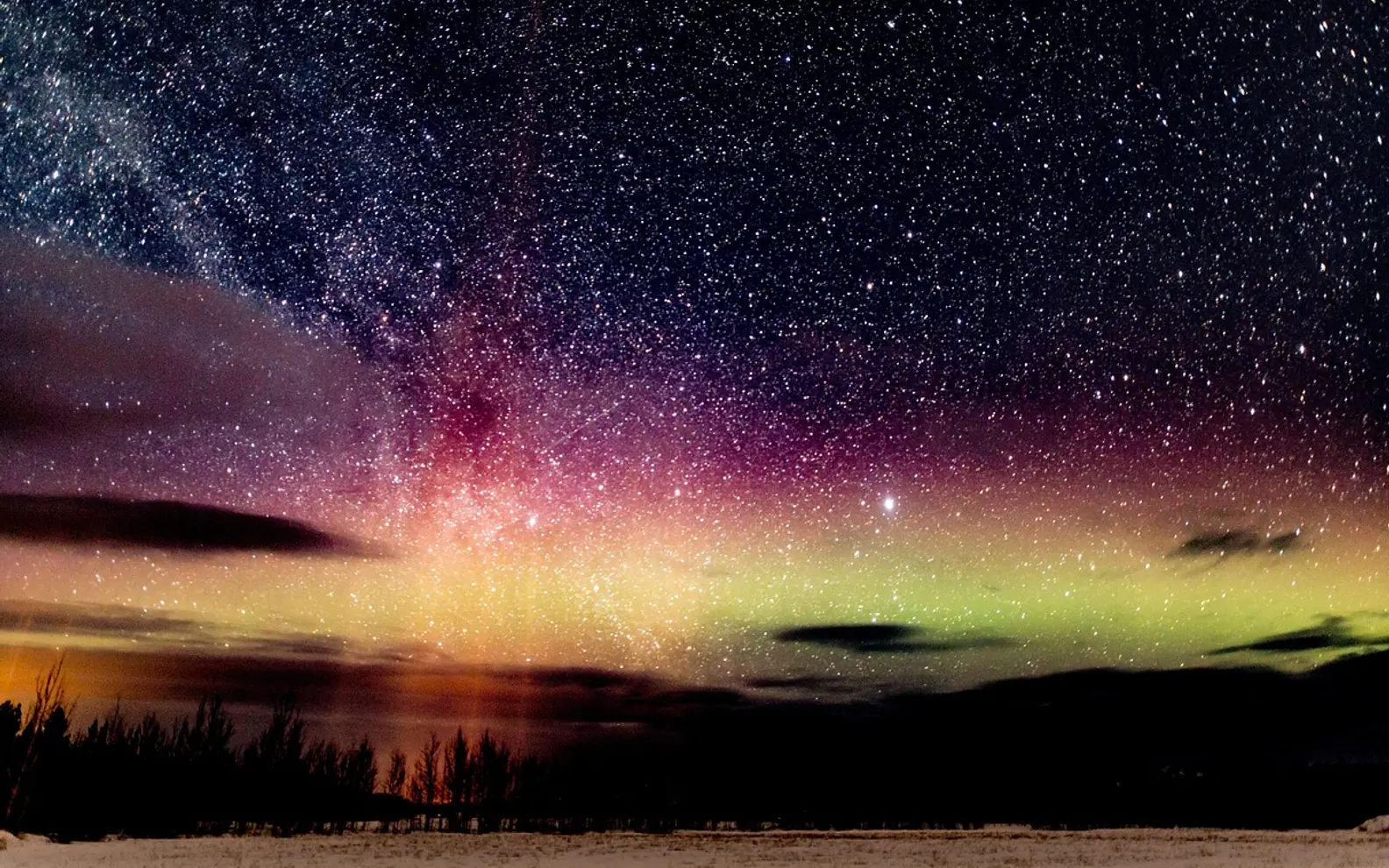
Few sights reward patience quite like the aurora borealis. One minute the sky above a frozen lake is plain and black; the next, a pale band rises over the horizon, thickens and starts to ripple in green, sometimes edged with pink or violet. Seeing it is never guaranteed, but you can tilt the odds firmly in your favor by understanding three things: where to stand, when to look and what the clouds are doing.
What you are actually looking at
The northern lights appear when charged particles streaming from the sun collide with gases high in Earth's atmosphere. The planet's magnetic field steers those particles toward the polar regions, which is why the glow gathers in a ring around the far north known as the auroral oval. Green is the color most people see, produced by oxygen at the altitude where the effect is strongest. Reds and purples tend to show up during stronger displays or higher in the sky.
Solar activity rises and falls over a cycle of roughly eleven years, and busier phases bring more frequent displays that reach further south. Even in quieter years the oval is active on many nights. The bigger obstacles are usually daylight and cloud, not the sun.
Where to go
Your best chances come from places that sit under or near the auroral oval and have long, dark nights in the colder months. Well-known regions include:
- Northern Norway, around Tromsø and the Lofoten islands, where mountains and fjords make a dramatic foreground.
- Finnish and Swedish Lapland, with inland forests, frozen lakes and often steadier winter weather than the coast.
- Iceland, easy to reach and full of open, unlit landscapes, though its weather can turn within the hour.
- Northern Canada and Alaska, including the areas around Yellowknife and Fairbanks, known for clear and very cold nights.
Within any of these regions, the most useful single move is to leave the town lights behind. A short drive to a dark lay-by, beach or lakeshore can turn a faint smudge into a proper show.
When to go
The aurora happens all year, but you can only see it against a truly dark sky. In the far north, summer nights are bright or barely dim, so the practical window runs from around late August or September to late March or early April. Many travelers aim for the months either side of deep midwinter, when nights are still long but the cold is slightly kinder.
On a given night, displays often peak in the hours around midnight, yet they can begin in early evening and flare again before dawn. Plan to spend several hours outside rather than one quick look, and allow at least three or four nights in the region so a single cloudy spell does not decide the whole trip.
Reading the forecasts
Two kinds of forecast matter, and you need both.
Aurora activity
Space weather services and aurora apps publish short-term predictions of geomagnetic activity, often on the Kp scale from 0 to 9. Higher numbers mean a stronger, wider oval. In the far north even modest values can produce a lovely display, so do not cancel plans because the figure looks low. Treat it as a hint about how hard to try, not a promise.
Cloud cover
This is the forecast that settles most nights. The brightest aurora is invisible behind thick cloud. Check local cloud maps through the afternoon and be ready to drive toward a clear gap. Guides who run aurora tours spend much of their evening doing precisely this.
A checklist for the night
- Dress in layers: thermal base, warm mid-layer and a windproof shell, plus hat, gloves and insulated boots.
- Pack a flask of something hot and a snack; waiting is part of the experience.
- Use a red-light headlamp so your eyes stay adjusted to the dark.
- Give your eyes fifteen to twenty minutes to adapt before deciding the sky is empty.
- Look north first, then scan the whole sky, as strong displays can spread overhead.
- Keep phone and camera batteries in an inside pocket, because cold drains them fast.
Photographing the aurora
Cameras often record more color than the eye does, especially with faint displays that look grey or milky in person. A camera on a tripod with a wide lens, manual focus set to infinity and exposures of a few seconds will usually capture vivid green. Many recent phones have a night mode that copes surprisingly well if you rest the phone on something steady. Take a handful of frames, then put the screen away and simply watch. A few lines written that night also hold on to details photos miss; our guide on how to start journaling has easy ways to begin.
Tours or going it alone?
Both work. A guided tour brings local knowledge, a vehicle that can chase clear skies and often warm overalls and hot drinks. Going independently gives you freedom and silence, but it means driving on winter roads at night, which calls for care and proper tires. Whichever you choose, tell someone your plans, check road conditions and never stop on a road edge to stare upward.
Keep expectations relaxed
The aurora is weather, not a scheduled performance. Some nights bring a faint arc; others fill the sky. Build the trip around more than the lights, with daytime walks, local food, saunas or wildlife, and a quiet night becomes part of the story rather than a letdown. If bucket-list journeys appeal, our look at private safaris in Tanzania explores a very different one.
Across the sections
Spotted a mistake?
A short note is enough.