576/7
How to Play Cribbage With Two Players: Deal, Pegging and the Show
Cribbage looks fiddly with its pegboard and odd vocabulary, but a two-player game follows a simple rhythm of deal, discard, peg and count. Here is every step, with a scored example.
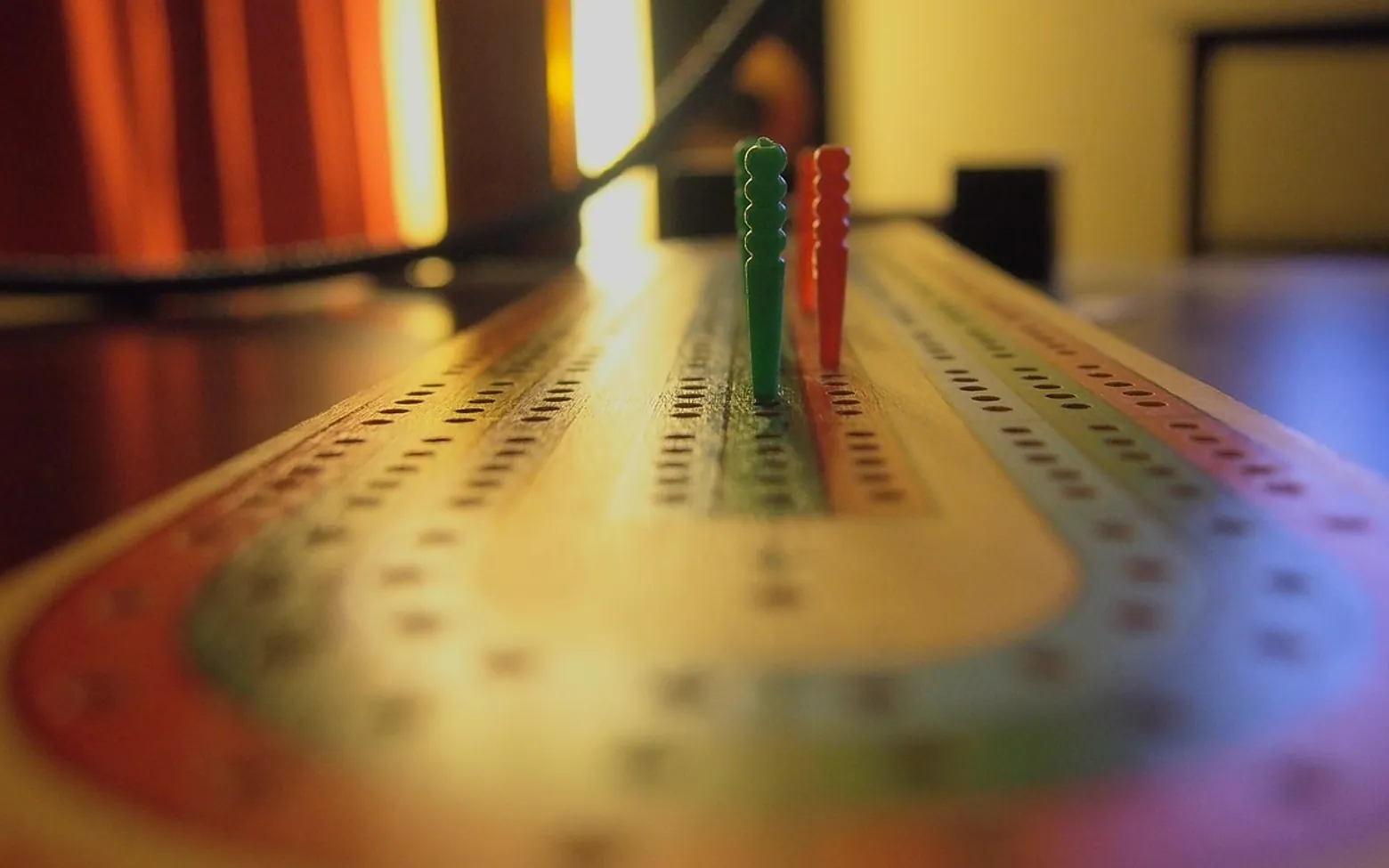
In two-player cribbage, each player gets six cards, throws two into a shared "crib" that belongs to the dealer, then both play cards in turn while scoring for fifteens, pairs, runs and reaching 31. After that, each hand is counted with a turned-up starter card, and points are moved along a pegboard. The first player to reach 121 wins. It sounds like a lot, but the same short cycle repeats every hand.
What you need
- A standard 52-card deck with no jokers.
- A cribbage board with two pegs per player. Paper and pencil work if no board is available.
- About half an hour for a full game to 121, less for a short game to 61.
Card values are simple: aces count 1, number cards count their face value, and jacks, queens and kings all count 10.
The deal and the crib
- Cut for deal. Each player cuts the deck; the lower card deals first. Aces are low.
- Deal six cards each, one at a time, face down.
- Discard two. Each player places two cards face down to form the crib. The crib is scored by the dealer at the end of the hand, which makes the deal an advantage that alternates every hand.
- Turn the starter. The non-dealer cuts the remaining deck and the dealer turns over the top card of the lower half. If it is a jack, the dealer pegs 2 points at once, traditionally called "two for his heels".
The play (pegging)
The non-dealer leads by laying one card face up and announcing its value. Players then alternate, each adding a card to their own pile and calling out the running total. The total may never pass 31. Points are scored immediately during the play:
| Event during the play | Points |
|---|---|
| Running total reaches exactly 15 | 2 |
| Running total reaches exactly 31 | 2 |
| Pair (same rank as the previous card) | 2 |
| Three of a kind in a row | 6 |
| Four of a kind in a row | 12 |
| Run of three or more consecutive ranks among the latest cards, in any order | 1 per card |
| "Go" (opponent cannot play without passing 31) | 1 to the last player who played |
| Last card of the whole play, if not exactly 31 | 1 |
When a player cannot lay a card without exceeding 31, they say "go". The other player keeps playing any cards that still fit. Once neither can play, the count resets to zero and play continues with the remaining cards, led by the player who did not play the last card. Pegging ends when both players have played all four cards.
The show: counting hands
Each player now picks their four cards back up and counts them together with the starter card. The order matters, because the game can end the moment someone reaches 121: the non-dealer counts first, then the dealer counts their hand, then the dealer counts the crib.
- Fifteens: every separate combination of cards adding to 15 scores 2.
- Pairs: each pair scores 2, so three of a kind (three pairs) scores 6 and four of a kind scores 12.
- Runs: three or more consecutive ranks score 1 per card. A duplicated card creates a double run, counted twice.
- Flush: four hand cards of one suit score 4, or 5 if the starter matches too. The crib only scores a flush when all four crib cards and the starter share a suit.
- Nobs: a jack in hand of the same suit as the starter scores 1.
A worked example
Your hand is 4, 5, 6, 6 and the starter is a jack of a suit you do not hold. Fifteens: 4-5-6 using the first six, 4-5-6 using the second six, and 5 with the jack, so three fifteens for 6 points. The pair of sixes adds 2. The double run of 4-5-6 adds 3 + 3 = 6. Total: 14 points. Counting aloud in a fixed order ("fifteen two, fifteen four, fifteen six, a pair is eight, and six for the runs is fourteen") makes mistakes much less likely.
The highest possible hand is 29: three fives and the jack of the remaining suit, with the fourth five turned as the starter in the jack's suit.
Strategy for new players
Discarding
When you are dealing, the crib is yours, so feed it cards that combine well: fives, pairs, and cards that add up to 15. When your opponent deals, keep fives and touching ranks such as 7-8 out of the crib whenever your own hand allows.
Leading and pegging
- Leading a card of 4 or lower is a common safe opening, since no single card can then bring the total to 15.
- Avoid leading a five; any ten-value card answers it for 2.
- Think before pairing your opponent's card: they may hold the third one for 6.
- Keep an eye on 31. Holding a low card back often earns the go or the last card.
Common mistakes
- Counting the crib before both hands, which can hand the game to the wrong player at the finish.
- Forgetting the starter card when counting fifteens and runs.
- Missing double runs, the most often overlooked points at the table.
- Moving the back peg instead of leapfrogging: the rear peg always jumps ahead of the front one, so the gap shows the last score.
Quick answers
Can cribbage be played without a board?
Yes. Keep a running tally on paper. The board simply makes scoring faster and harder to get wrong.
Is there a shorter version?
Many households play to 61, once around a standard board, when time is short.
What else suits a two-person card night?
For more ideas, our overview of two-player board games covers duels, cooperative games and classic card games side by side. If you would rather sit with a solo puzzle afterwards, the walk-through on how to play sudoku is a gentle place to start.
Across the sections
Spotted a mistake?
A short note is enough.