452/7
How to Play Sudoku: Rules, First Moves and Solving Techniques
Sudoku has a single rule and needs no arithmetic at all. These are the scanning habits and note-taking methods that carry a beginner from easy grids to harder ones.
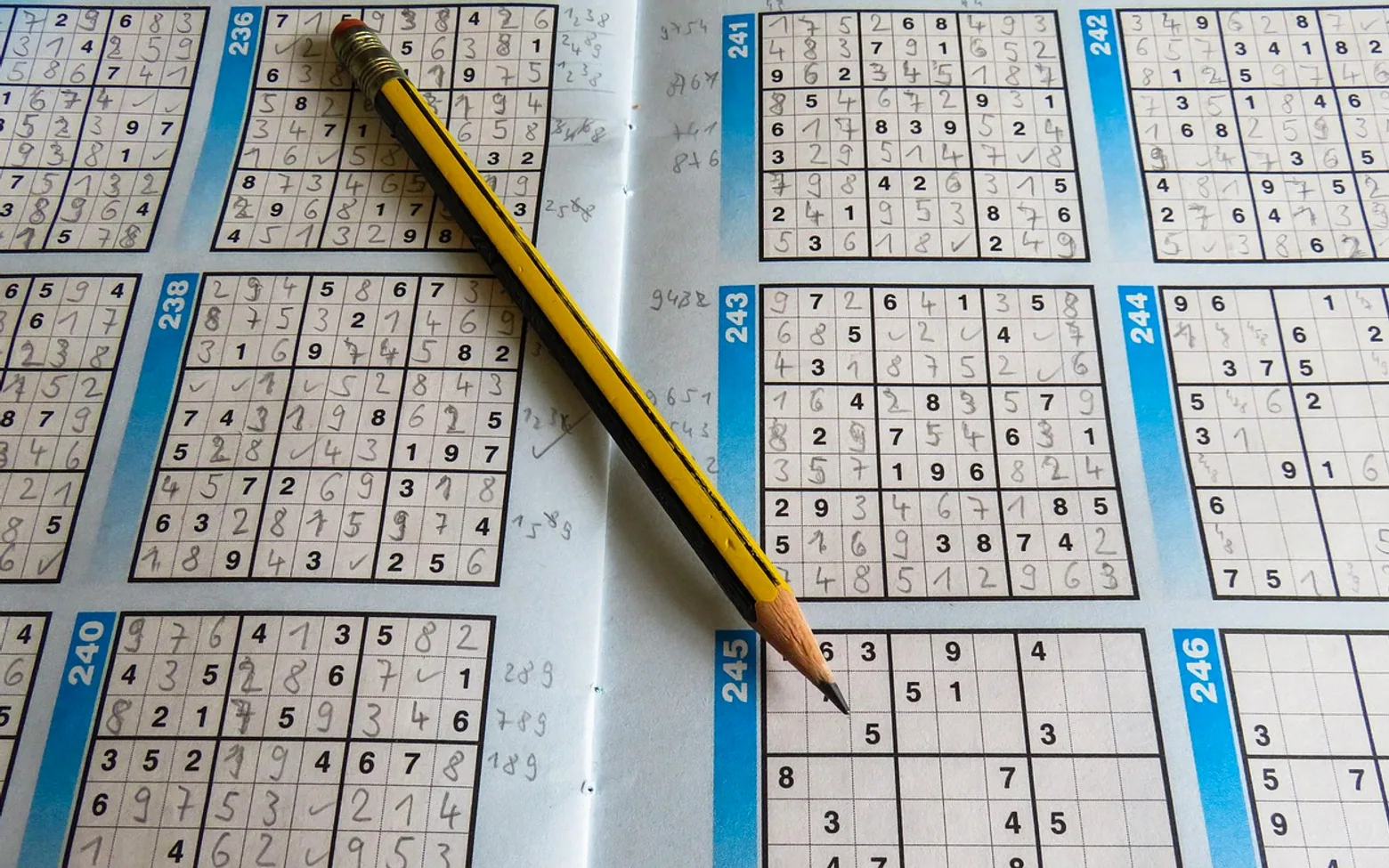
Sudoku is played on a 9×9 grid divided into nine 3×3 boxes. Some squares already hold digits; your task is to fill the rest so that every row, every column and every box contains each digit from 1 to 9 exactly once. That is the whole rule. No sums are involved, and the digits could just as well be letters or colours. A well-made puzzle has only one solution, which means you never need to guess.
A little background
The puzzle first appeared in an American puzzle magazine in the late 1970s under the name Number Place. A Japanese puzzle publisher later gave it the name sudoku, and newspapers in Britain and the United States turned it into a daily fixture in the mid-2000s. Today it sits beside crosswords as one of the most familiar pencil puzzles there is.
Key terms
- Cell: one of the 81 small squares.
- Row, column, box: the three kinds of "unit", each holding nine cells.
- Givens: the digits printed at the start.
- Candidates: the digits that could still go in an empty cell.
- Pencil marks: small notes you write in a cell to track its candidates.
Step by step: your first moves
- Pick a digit, not a cell. Choose a digit that appears often among the givens, say 7.
- Scan across a band of three boxes. If two of the boxes in a horizontal band already contain a 7, the third box's 7 must sit in the one row those two do not use.
- Scan down the stacks the same way. Combining a row restriction and a column restriction often leaves exactly one cell for the 7 in a box. Write it in.
- Repeat for every digit. Then go round again; each new digit opens up fresh deductions.
- Look for nearly full units. A row with eight digits filled tells you the ninth immediately; one with seven usually needs only a quick check.
This sweeping method, often called cross-hatching, solves most easy puzzles without a single note.
When scanning stops working: pencil marks
Medium and hard puzzles reach a point where no digit can be placed by scanning alone. That is the moment to write candidates. Two systems are common:
- Full notes: list every possible digit in each empty cell. Thorough, though busy on paper.
- Corner marks: only note a digit when it can go in just two places within a box, writing it small in the corner of both cells. Cleaner, and many solvers find it easier to read.
Each time you place a digit, remove it from the notes of every cell in the same row, column and box. Skipping this tidy-up is the main source of errors.
Core solving techniques
| Technique | What to look for | Typical level |
|---|---|---|
| Naked single | A cell with only one candidate left | Easy |
| Hidden single | A digit that fits in only one cell of a unit, even if that cell has other candidates | Easy |
| Naked pair | Two cells in a unit sharing the same two candidates; remove those digits from the rest of the unit | Medium |
| Pointing pair | Within a box, a digit confined to one row or column; eliminate it from that line outside the box | Medium |
| Box-line reduction | Within a row or column, a digit confined to one box; eliminate it from the rest of that box | Medium |
| Hidden pair | Two digits that appear only in the same two cells of a unit; clear other candidates from those cells | Medium to hard |
| X-wing | A digit limited to the same two columns in two rows, forming a rectangle that allows eliminations | Hard |
You do not need to memorise all of these at once. Singles and pairs carry you through the vast majority of newspaper puzzles; the advanced patterns become useful only on the hardest grids.
Naked versus hidden, explained
A naked single is visible inside the cell: its notes show one digit. A hidden single is visible across the unit: the cell may list three candidates, but one of those digits appears nowhere else in its row, column or box, so it must go there. Learning to spot hidden singles is usually the leap that turns a stuck solver into a confident one.
Mistakes beginners make
- Guessing. A guess that happens to work hides a missed deduction; one that fails can spoil the whole grid.
- Writing in pen too early. Use a pencil with a good eraser, or an app with an undo button.
- Forgetting to update notes after placing a digit.
- Staring at one corner. When stuck, change digits or switch to scanning columns instead of rows.
- Jumping to hard puzzles. Difficulty labels vary between sources, so start at the easiest level a source offers and move up only when it feels quick.
Variants to try next
- Mini sudoku on 4×4 or 6×6 grids, ideal for children.
- Killer sudoku, where dotted cages show the sum of the digits inside them.
- Diagonal sudoku, which adds the two long diagonals as extra units.
- Samurai sudoku, five overlapping grids sharing their corner boxes.
Questions about sudoku
Do you need to be good at maths?
No. Sudoku is pure logic about placement. The only exception is killer sudoku, which adds simple addition.
How long should a puzzle take?
It varies enormously with difficulty and experience. Speed comes naturally once scanning becomes a habit, so there is no reason to time yourself early on.
What other quiet puzzles work well at home?
Jigsaws use a similar mix of sorting and patient elimination; see our tips on how to start a jigsaw puzzle. For something played across the table instead, two-player cribbage rewards the same habit of counting carefully before acting.
Across the sections
Spotted a mistake?
A short note is enough.